Showing posts with label Atmosphere. Show all posts

Thursday, January 23, 2014

ATMOSPHERE


The atmosphere of Earth is a layer of gases surrounding the planet Earth that is retained by Earth's gravity. The atmosphere protects life on Earth by absorbing ultraviolet solar radiation, warming the surface through heat retention (greenhouse effect), and reducing temperature extremes between day and night (the diurnal temperature variation). (Wikipedia Definition - more information here)


In general, air pressure and density decrease in the atmosphere as height increases. In this way, Earth's atmosphere can be divided into five main layers. From highest to lowest, these layers are:
  1. The troposphere is the first layer above the surface and contains half of the Earth's atmosphere. Weather occurs in this layer. 
  2. Many jet aircrafts fly in the stratosphere because it is very stable. Also, the ozone layer absorbs harmful rays from the Sun. 
  3. Meteors or rock fragments burn up in the mesosphere. 
  4. The thermosphere is a layer with auroras. It is also where the space shuttle orbits. 
  5. The atmosphere merges into space in the extremely thin exosphere. This is the upper limit of our atmosphere.

The Composition of Our Atmosphere – What Is In The Air

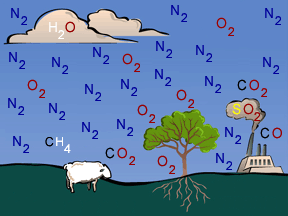
The most abundant gases found in our atmosphere are nitrogen and oxygen. Nitrogen makes up around 78% of the total atmosphere, while oxygen makes up 21%. The remaining 1% is made up mostly of a gas called argon. This means that with each breath you take you are breathing 78% nitrogen, 21% oxygen and 1% argon, with trace amounts of other gases, such as methane, hydrogen, helium, neon, krypton, carbon dioxide, and a form of oxygen known as ozone.


Monday, October 29, 2012

The Composition of Our Atmosphere – What Is In The Air

The most abundant gases found in our atmosphere are nitrogen and oxygen. Nitrogen makes up around 78% of the total atmosphere, while oxygen makes up 21%. The remaining 1% is made up mostly of a gas called argon. This means that with each breath you take you are breathing 78% nitrogen, 21% oxygen and 1% argon, with trace amounts of other gases, such as methane, hydrogen, helium, neon, krypton, carbon dioxide, and a form of oxygen known as ozone.

THE LAYERS OF THE ATMOSPHERE


  1. The troposphere is the first layer above the surface and contains half of the Earth's atmosphere. Weather occurs in this layer. 
  2. Many jet aircrafts fly in the stratosphere because it is very stable. Also, the ozone layer absorbs harmful rays from the Sun. 
  3. Meteors or rock fragments burn up in the mesosphere. 
  4. The thermosphere is a layer with auroras. It is also where the space shuttle orbits. 
  5. The atmosphere merges into space in the extremely thin exosphere. This is the upper limit of our atmosphere.

Tuesday, January 10, 2012

Air

Air is mainly composed of nitrogen, oxygen, and argon, which together constitute the major gases of the atmosphere.
  • Nitrogen - 78%
  • Oxygen - 21%
  • Argon, Carbon Dioxide and other gases - 1%

Monday, January 9, 2012

Structure of the Atmosphere

In general, air pressure and density decrease in the atmosphere as height increases. In this way, Earth's atmosphere can be divided into five main layers. From highest to lowest, these layers are:


The Atmosphere of Earth


The atmosphere of Earth is a layer of gases surrounding the planet Earth that is retained by Earth's gravity. The atmosphere protects life on Earth by absorbing ultraviolet solar radiation, warming the surface through heat retention (greenhouse effect), and reducing temperature extremes between day and night (the diurnal temperature variation). (Wikipedia Definition - more information here)